
What is a Triangle?
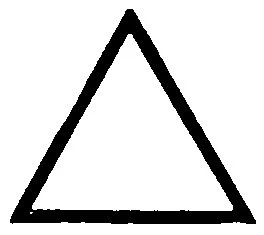
A triangle, in its most common geometric sense, is a closed two-dimensional shape (polygon) with three straight sides and three angles. It is formed when three non-collinear points are connected pairwise by line segments, creating a three-sided boundary. In Euclidean geometry, the sum of the interior angles of a triangle is always 180 degrees.
Key characteristics:
Sides: Three straight line segments.
Vertices (corners): Three points where the sides meet.
Angle Sum: In Euclidean geometry, interior angles add up to 180 degrees.
Types: Triangles can be categorized by side lengths (equilateral, isosceles, scalene) and by angles (acute, right, obtuse).
Despite their simplicity, triangles serve as fundamental building blocks in geometry and are widely used in fields from architecture to computer graphics because of their inherent structural stability and ease of calculation.

Triangles vs Ovals: What's the Difference?
Triangles vs Ovals: What's the Difference?
Triangles and ovals both represent closed shapes, but they differ in fundamental ways—both mathematically and in how they appear and are used.
Structure and Form
Triangles
Sides and Vertices: A triangle has three straight sides and three vertices.
Angles: In Euclidean geometry, the interior angles of a triangle always sum to 180°.
Edges and Corners: Triangles have distinct edges (sides) and corners (vertices).
Ovals
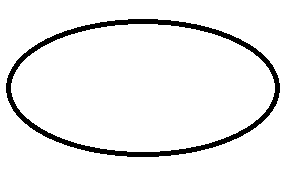
Curved Boundary: An oval (in everyday language) typically refers to any smooth, convex curve resembling an elongated circle—often an ellipse, which has no straight edges.
No Angles or Vertices: Because an oval is continuously curved, it has no corners or edges in the polygonal sense, and thus no measurable angles like a polygon.
Mathematical Properties
Triangles:
Polygonal Nature: Because they are polygons, triangles follow rules (e.g., angle sum = 180°) and can be categorized by side lengths (equilateral, isosceles, scalene) or angles (acute, right, obtuse).
Foundational Shape: Triangles are often used in geometry to decompose more complex shapes, forming the basis of trigonometry and much of polygonal geometry.
Ovals (Ellipses):
Smooth Curvature: They do not have sides, so any “length” around the shape must be calculated using more advanced formulas (for ellipses, this involves elliptic integrals).
Symmetry: An ellipse has two axes of symmetry (major and minor axes), unlike a circle (special case of an ellipse) which has infinite axes of symmetry. “Ovals” in casual usage vary widely in shape—some may have no exact axes of symmetry at all.
Real-World Applications
Triangles:
Structural Stability: Triangles are known for being inherently rigid; engineers often use triangular frameworks (trusses) for bridges, roofs, and other load-bearing structures.
Computer Graphics: Triangles form the basic “building blocks” for 3D modeling and rendering since any complex polygon can be triangulated.
Ovals:
Design and Aesthetics: Ovals/circles have a softer visual appeal, often used in logos, product designs, and artwork to evoke friendliness or natural harmony.
Optics and Physics (Ellipses): Elliptical orbits in astronomy, elliptical mirrors in optical devices, and elliptical gear systems all rely on the unique mathematical properties of ellipses.
Key Contrasts
Edges vs. Curves: Triangles are polygonal with distinct edges; ovals are smooth curves.
Angles vs. No Angles: Triangles feature three angles; ovals have none in the polygonal sense.
Rigid vs. Fluid Structure: Triangles’ rigidity makes them common in construction and engineering; ovals’ continuous curvature lends them to designs where flow and smoothness are desirable.
Bottom line: Triangles are the simplest polygon, prized for structural and computational clarity. Ovals—especially ellipses—introduce continuous curvature, widely used for aesthetic and scientific purposes. Both shapes are central in geometry, each with unique properties and applications.