

Is your pitch lacking context?

You know how your industry works. Most other people don’t. And most investors probably don’t either.
Because of that, you might have to educate them. Otherwise, they won’t understand the real value and impact of your product.
And that’s why in some cases, we like to add a context slide.
A context slide sets the scene for the rest of the deck, and should come after the intro slide and before any slides on the problem, product, market, etc.
To demonstrate this, I’ll give an example.
Wakeboarding example
Say I’m a wakeboarder selling something to wakeboarders.
And let’s say I want to raise money for that thing. A lot of the investors I’m going to talk to might not even know what wakeboarding is or how people do it.
So I should add a slide with a headline that says “Wakeboarding is like water skiing, but on a board instead of skis.”
Then a subtitle under that headline that says “There are two ways to wakeboard - behind a boat or at a cable park”.
Then some pictures with labels on the slide to demonstrate.
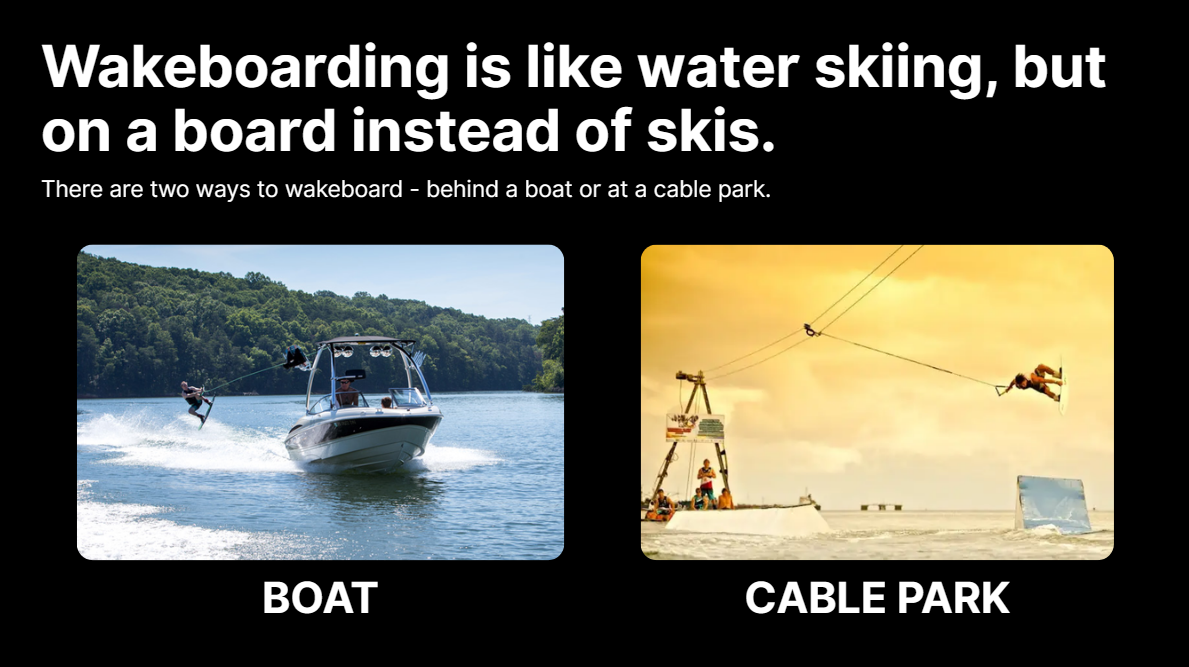
After that slide, I could dive into the problems and struggles wakeboarders face, now in context and understandable to absolutely anyone.
Who should do this?
Every deck needs some level of context to set the scene. That could be an entire dedicated slide like in the example, or it could just be a well-done “problem” or “market timing” slide.
Either way, the point is this: make your deck understandable to everyone. Assume everyone reading it has no clue what you’re talking about. Start all the way at zero with them.
Of course, you will find yourself in situations where the investor does know the industry well. In that case, you can make a new slightly altered version of the deck or remove a slide if needed.
Good luck with everything and watch out for next Friday’s email!
Best,
Nathan